How Tone Works with Low Class Consonants
Low Class consonants are unique in how they interact with tone marks and syllable types. While Middle and High class tone marks align directly with Low and Falling tones, Low class tone marks shift up by one tone level:
The Low Class "Step-Up" Rule
- mái èek ( ่ ) does NOT produce a Low tone — it produces a Falling tone (e.g. khâa, nâa)!
- mái thoo ( ้ ) does NOT produce a Falling tone — it produces a High tone (e.g. kháa, máa)!
Low Class Tone Chart
| Tone Mark / Syllable | Example | Transliteration | Pitch Contour | Resulting Tone |
|---|---|---|---|---|
| None (Live Syllable Live SyllableA syllable ending in a long vowel or a sonorant consonant (m, n, ng, y, w). It can sustain a continuous, ringing pitch.Examples: คา (khaa), มา (maa)) | คา | khaa | Natural uninflected mid pitch | Mid Tone |
| mái èek ( ่ ) | ค่า | khâa | Starts high and drops down | Falling Tone |
| mái thoo ( ้ ) | ค้า | kháa | High pitch held steady | High Tone |
| Dead Syllable Dead SyllableA syllable ending in a short vowel with no final consonant, or ending in an abrupt stop consonant (p, t, k).Examples: คะ (khá), คาด (khâat) + Short Vowel | คะ / รัก | khá / rák | Abrupt cut-off on a high pitch | High Tone |
| Dead Syllable + Long Vowel | คาด / มาก | khâat / mâak | High start dropping abruptly | Falling Tone |
Group 1: 14 Paired Consonants (อักษรต่ำคู่)
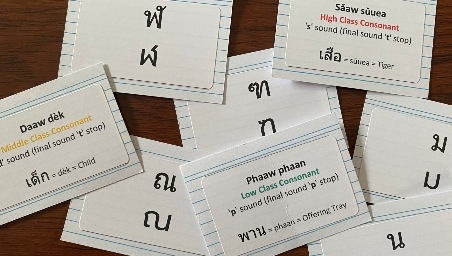
These consonants have matching aspirated stop Aspirated StopsConsonant sounds released with an audible puff of breath (like 'p' in English "pin" or 't' in "tea").Thai pairs: ค/ข, ช/ฉ, พ/ผ or fricative FricativesConsonant sounds produced by forcing air through a narrow channel in your vocal tract.Thai pairs: ซ/ส, ฟ/ฝ, ฮ/ห partners in the High Class. By alternating between the Low Class consonant (Mid, Falling, High) and the High Class partner (Low, Rising), speakers can express every tone for that sound!
Group 2: 10 Single Sonorants (อักษรต่ำเดี่ยว)
These 10 letters are sonorants Sonorant ConsonantsSmooth, continuous voiced sounds (like 'm', 'n', 'l', or 'y') produced with resonance rather than friction.Thai letters: ง, ญ, ณ, น, ม, ย, ร, ล, ว, ฬ (nasals, liquids, glides). They have no High Class partners. To pronounce them with Rising, Low, or Falling tones, written Thai uses silent Leading ห (ห นำ).