Script & Tone Foundations

The 3 Thai Consonant Classes: High, Middle & Low

Every one of the 44 Thai consonants is born into one of three tone classes. Learn why consonant classes exist, how they control the spoken tone of words, and how special leading consonants shift the rules.

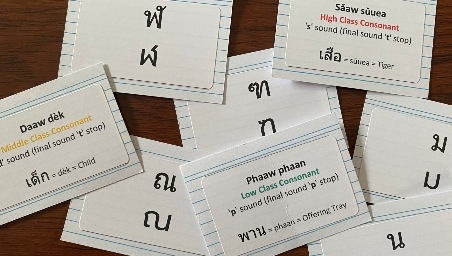
Thai consonant classes flashcards
Middle Class • อักษรกลาง

9

Consonants

The most regular group. Can pronounce all 5 tones naturally when combined with standard tone marks.

View Middle Consonants
High Class • อักษรสูง

11

Consonants

Naturally aspirated stops Aspirated StopsConsonant sounds made with an audible puff or release of air (like the 'p' in English "pin" or 't' in "tea").Thai examples: ข (kh), ถ (th), ผ (ph) and fricatives FricativesConsonant sounds created by squeezing air through a narrow channel in your vocal tract, producing a continuous friction or hiss.Thai examples: ส / ศ / ษ (s), ฝ (f), ห (h). Syllables without tone marks produce an inherent rising tone.

View High Consonants
Low Class • อักษรต่ำ

24

Consonants (10 Unpaired + 14 Paired)

The largest group. Syllables without tone marks produce a mid tone. Tone marks shift tone by one step up.

View Low Consonants
Fundamental Rule

How Consonant Class Determines the Tone of a Word

Thai is a tonal language with five distinct tones: Mid, Low, Falling, High, and Rising. Changing the pitch contour completely changes the word's meaning.

Many beginners ask: "If Thai has tone marks, why do we need consonant classes?" The answer is simple:

1. Most Thai syllables have NO visible tone mark written above them. When a word has no tone mark, its tone is decided automatically by the class of the initial consonant together with whether the syllable is "live" or "dead" (vowel length & final consonant).

2. A tone mark produces DIFFERENT tones depending on the consonant's class! For instance, the tone mark  ่  (mái èek) produces a Low tone on Middle and High class consonants, but produces a Falling tone on Low class consonants.

Quick Comparison: Unmarked Live Syllables (No Tone Mark)

Notice how the default baseline tone (the "inherent tone") changes purely based on the initial consonant's class when paired with a long vowel:

Class Example Word Initial Consonant Transliteration Meaning Resulting Tone
Middle กา ก (gaaw gài) gaa Crow / Teapot Mid Tone
High ขา ข (khǎaw khài) khǎa Leg Rising Tone
Low คา ค (khaaw khwaai) khaa Stuck / Lodged Mid Tone

Even though neither word above has a tone mark, กา is Mid tone, ขา is Rising tone, and คา is Mid tone — purely determined by their initial consonant classes!

Class 1 of 3

Middle Class Consonants (อักษรกลาง) • 9 Letters

9 Consonants

Middle class consonants are the easiest and most versatile group in Thai. They include unaspirated stops Unaspirated StopsConsonant sounds made without a burst or puff of air upon release (like the 'p' in English "spin", 't' in "stop", or 'k' in "skin").Thai examples: ก (g/k), จ (j), ต/ฏ (dt), ป (bp) and the glottal stop Glottal StopA brief closure and sudden release of the vocal cords that cuts off airflow (like the catch in your throat in the middle of "uh-oh").Thai example: อ (aaw àang) when acting as an initial consonant. When paired with the 4 Thai tone marks, Middle class consonants can pronounce all 5 Thai tones:

Mnemonic Trick: Thai schoolchildren memorize middle consonants with the famous phrase:
"ไก่ จิก เด็ก ตาย บน ปาก โอ่ง" (Gài jìk dèk dtaai bon bpàak òong — Chicken pecks a child dead on top of the water jar).

ก
ก ไก่
gaaw gài • Chicken
Sound: g / k
Play
จ
จ จาน
jaaw jaan • Plate
Sound: j / t
Play
ฎ
ฎ ชฎา
daaw chá-daa • Dance Hat
Sound: d / t
Play
ฏ
ฏ ปฏัก
dtaaw bpà-dtàk • Harpoon
Sound: dt / t
Play
ด
ด เด็ก
daaw dèk • Child
Sound: d / t
Play
ต
ต เต่า
dtaaw dtào • Turtle
Sound: dt / t
Play
บ
บ ใบไม้
baaw bai-máai • Leaf
Sound: b / p
Play
ป
ป ปลา
bpaaw bplaa • Fish
Sound: bp / p
Play
อ
อ อ่าง
aaw àang • Tub / Bucket
Sound: - (glottal stop Glottal StopA brief stoppage and release of air at the vocal cords (like the catch in the middle of "uh-oh"). Acts as a neutral vowel carrier in Thai.)
Play
Class 2 of 3

High Class Consonants (อักษรสูง) • 11 Letters

11 Consonants

High class consonants are aspirated stops Aspirated StopsConsonant sounds released with a noticeable puff of breath (like 'p' in English "pin" or 't' in "tea").Thai examples: ข (kh), ถ / ฐ (th), ผ (ph), fricatives FricativesConsonant sounds produced by forcing air through a narrow vocal passage, creating an audible hiss.Thai examples: ฝ (f), ส / ศ / ษ (s), and the voiceless glottal fricative Voiceless Glottal FricativeA breathy 'h' sound made purely by rushing air through open vocal cords without vocal cord vibration (exactly like the English 'h' in "hat" or "house").Thai letter: ห (hǎaw hìip) (ห). In their natural unadorned state (no tone mark, live syllable), they produce an inherent rising tone (e.g. khǎa, hǎa, sǔuea).

Note that two consonants — ฃ (khǎaw khùuat) in the high class group and ฅ (khaaw khon) in the low class group — are obsolete in modern written Thai, but remain in the historical alphabet.

ข
ข ไข่
khǎaw khài • Egg
Sound: kh / k
Play
ฃ
ฃ ขวด Obsolete
khǎaw khùuat • Bottle
Sound: kh / k
Play
ฉ
ฉ ฉิ่ง
chǎaw chìng • Small Cymbal
Sound: ch / n/a
Play
ฐ
ฐ ฐาน
thǎaw thǎan • Pedestal
Sound: th / t
Play
ถ
ถ ถุง
thǎaw thǔng • Shopping Bag
Sound: th / t
Play
ผ
ผ ผึ้ง
phǎaw phûeng • Bee
Sound: ph / n/a
Play
ฝ
ฝ ฝา
fǎaw fǎa • Lid
Sound: f / n/a
Play
ศ
ศ ศาลา
sǎaw sǎa-laa • Pavilion
Sound: s / t
Play
ษ
ษ ฤๅษี
sǎaw ruue-sǐi • Hermit
Sound: s / t
Play
ส
ส เสือ
sǎaw sǔuea • Tiger
Sound: s / t
Play
ห
ห หีบ
hǎaw hìip • Chest / Box
Sound: h / n/a
Play
Class 3 of 3

Low Class Consonants (อักษรต่ำ) • 24 Letters

24 Consonants

With 24 letters, Low class is by far the largest consonant group. Because it is so large, linguists and teachers split Low class into two important sub-categories:

1. Paired Low Consonants (14 letters)

These consonants have the same basic pronunciation as counterpart consonants in the High class (e.g. ค / ข both sound like 'kh', ท / ถ both sound like 'th'). Together, paired low and high consonants cover complementary tones across the language.

Letters: ค, ฅ, ฆ, ช, ซ, ฌ, ฑ, ฒ, ท, ธ, พ, ฟ, ภ, ฮ

2. Single / Unpaired Low Consonants (10 sonorants Sonorant ConsonantsNaturally smooth, voiced, musical sounds (nasals and liquids) produced with continuous resonance rather than turbulent air friction (like English 'm', 'n', 'ng', 'r', 'l', 'w', 'y').Thai letters: ง, ญ, ณ, น, ม, ย, ร, ล, ว, ฬ)

These are nasal and liquid sonorant SonorantA voiced consonant sound produced without turbulence in the vocal tract (such as 'm', 'n', 'r', 'l').English: "moon", "rain", "light", "win" sounds (m, n, ng, r, l, w, y) that have no natural high-class phonetic twin. This is precisely why leading ห exists — to allow these 10 sonorants to be pronounced with high-class tone rules!

Letters: ง, ญ, ณ, น, ม, ย, ร, ล, ว, ฬ

All 24 Low Class Consonants:

ค
ค ควาย
khaaw khwaai • Buffalo
Sound: kh / k
Play
ฅ
ฅ คน Obsolete
khaaw khon • Person
Sound: kh / k
Play
ฆ
ฆ ระฆัง
khaaw rá-khang • Bell
Sound: kh / k
Play
ง
ง งู Sonorant
ngaaw nguu • Snake
Sound: ng / ng
Play
ช
ช ช้าง
chaaw cháang • Elephant
Sound: ch / t
Play
ซ
ซ โซ่
saaw sôo • Chain
Sound: s / s
Play
ฌ
ฌ เฌอ
chaaw chuuhr • Tree
Sound: ch / t
Play
ญ
ญ หญิง Sonorant
yaaw yǐng • Woman
Sound: y / n
Play
ฑ
ฑ มณโฑ
thaaw mon-thoo • Mythic Queen
Sound: th / t
Play
ฒ
ฒ ผู้เฒ่า
thaaw phûu-thâo • Elder
Sound: th / t
Play
ณ
ณ เณร Sonorant
naaw neen • Novice Monk
Sound: n / n
Play
ท
ท ทหาร
thaaw thá-hǎan • Soldier
Sound: th / t
Play
ธ
ธ ธง
thaaw thong • Flag
Sound: th / t
Play
น
น หนู Sonorant
naaw nǔu • Mouse
Sound: n / n
Play
พ
พ พาน
phaaw phaan • Offering Tray
Sound: ph / p
Play
ฟ
ฟ ฟัน
faaw fan • Tooth
Sound: f / p
Play
ภ
ภ สำเภา
phaaw sǎm phao • Junk Boat
Sound: ph / p
Play
ม
ม ม้า Sonorant
maaw máa • Horse
Sound: m / m
Play
ย
ย ยักษ์ Sonorant
yaaw yák • Giant / Demon
Sound: y / vowel
Play
ร
ร เรือ Sonorant
raaw ruuea • Boat
Sound: r / n
Play
ล
ล ลิง Sonorant
laaw ling • Monkey
Sound: l / n
Play
ว
ว แหวน Sonorant
waaw wǎaen • Ring
Sound: w / vowel
Play
ฬ
ฬ จุฬา Sonorant
laaw jù-laa • Chula Kite
Sound: l / n
Play
ฮ
ฮ นกฮูก
haaw nók-hûuk • Owl
Sound: h / n/a
Play
Tone Changers

Leading Consonants: Leading ห (hǎaw hìip) & Leading อ (aaw àang)

Thai spelling has a brilliant phonetic mechanism: what if you have a word with a sonorant Sonorant ConsonantsContinuous, smooth, voiced sounds (like 'm', 'n', 'l', or 'y') produced with resonant airflow rather than friction.Thai letters: ง, ญ, ณ, น, ม, ย, ร, ล, ว, ฬ consonant (like m, n, l, or y), but you need it to be spoken in a Rising tone or a Low tone with standard tone marks?

Because unpaired low consonants cannot produce high or middle tone rules on their own, the Thai writing system places a silent leading consonant in front of the syllable. The leading consonant is not pronounced, but it lends its tone class to the entire syllable!

ห

Leading ห (ห นำ • hǎaw nam): Shifts Words to High Class

The letter ห (hǎaw hìip) belongs to the High class. When placed silently before any of the 8 unpaired low consonants (ง, ญ, น, ย, ม, ร, ล, ว), it converts the syllable so that it follows High class tone rules!

Without ห: มา → maa (come)

Low class ม + live syllable = Mid Tone

With leading ห: หมา → mǎa (dog)

Silent ห gives High class status = Rising Tone

Without ห: นา → naa (rice field)

Low class น = Mid Tone

With leading ห: หนา → nǎa (thick)

High class rule applied = Rising Tone

Common everyday examples with leading ห: หมู (mǔu - pig/pork), ใหม่ (mài - new), หนังสือ (nǎng-sǔue - book), and หวัดดี (wàt-dii - hi).

อ

Leading อ (อ นำ • aaw nam): Shifts Words to Middle Class

The letter อ (aaw àang) belongs to the Middle class. When placed silently before the consonant ย (yaaw yák), it changes the word so that it follows Middle class tone rules!

In the entire Thai language, there are only 4 specific words that start with leading silent อ before ย. You can easily memorize all four:

อย่า

yàa

Don't (imperative)

Low Tone

อยู่

yùu

To be / Live / Stay

Low Tone

อย่าง

yàang

Kind / Sort / Like

Low Tone

อยาก

yàak

To want / Desire

Low Tone

Because อ is Middle class, applying the mái èek tone mark ( ่ ) yields a Low Tone (yàa, yùu, yàang), and the dead syllable with short/long vowel gives a Low Tone (yàak).

Practice & Retain

Put Your Consonant Class Knowledge into Practice

Reinforce the High, Middle, and Low classes with our interactive flashcards, complete reference list, and drag-and-drop class sorter game.

Ready to continue your journey? Return to the step-by-step beginners roadmap anytime.

Copyright © 2026 Fun to Learn Thai Ltd. All Rights Reserved.